


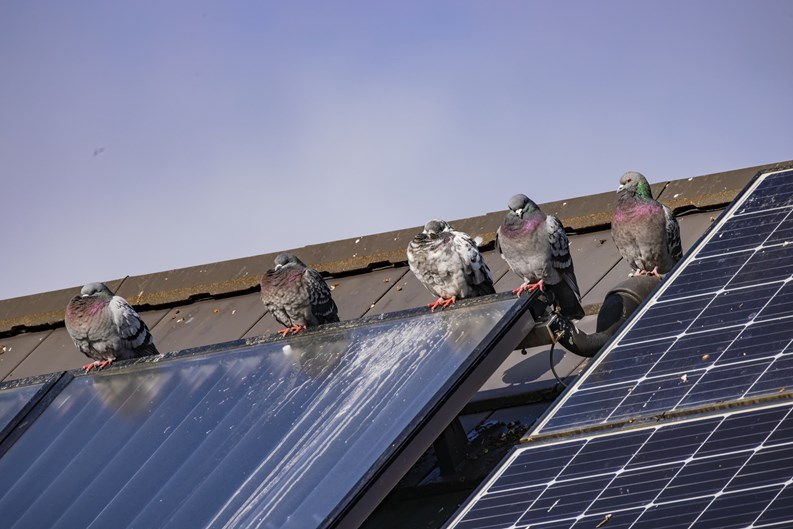
Cities are known for being home to diverse populations that thrive in fast-paced, crowded environments—and not all of those populations are human. The same dense landscape that attracts people also attracts bold, resourceful, and highly adaptable birds. Boston alone is home to hundreds of bird species, including cardinals, robins, sparrows, woodpeckers, and of course, pigeons.
In fact, while there is no official 2026 census for urban birds, wildlife experts and researchers generally estimate the pigeon population in Boston to be somewhere between 50,000 and 100,000. That’s around one pigeon apiece for every 10 to 15 city dwellers. And while the ubiquitous bird isn’t vicious by any means, its presence can lead to unsanitary conditions, health problems, and even structural damage, making it more of a nuisance than a joy for multifamily building residents. Let’s take a closer look at what buildings can do to mitigate and manage some of the more annoying side effects of these avian adversaries.
A Health Hazard
Like us, birds seek out food, comfort, and safety. They look for spots protected from wind and rain—a covered ledge on a sill, or inside an awning, for example. One urban bird removal pro notes that the areas of a building most susceptible to bird activity are places that make birds feel safe and secure. “It could be an I-beam in a parking garage; it could be a sprinkler system pipe that runs through an entire area,” he says. “They’ll sit on top of those pipes, on top of lights—they particularly love signage and windowsills—and if they’re above where people are walking, then you’re right in the line of fire.”
And that’s usually the first sign that a building has a bird problem: droppings. Aside from being smelly, unsightly, and generally gross, bird droppings can carry serious respiratory diseases, as well as parasites that can infiltrate people’s homes if there’s a bird nest near an open window, fan, or air conditioner. According to Assured Environments, a pest control company that services multifamily properties in Connecticut, New York, and New Jersey, “Birds themselves are a vector for disease. Their feathers, droppings, and nests can all contain potentially dangerous pathogens [like] salmonella, meningitis, tuberculosis, and encephalitis. Combine pigeon fleas, pigeon parasites, and diseased pigeon feces with an infestation, and you’ve got an extremely bad, possibly disastrous situation.”
Health authorities across New England, including the Massachusetts Department of Public Health (DPH) and the Boston Public Health Commission (BPHC), treat significant accumulations of bird droppings (guano) as a serious public health concern, noting that prompt, proper clean-up of bird droppings is essential for preventing these types of illnesses and infestations. Property owners are responsible for cleaning up pigeon droppings on or originating from their buildings, but according to municipal health agencies, by the time there are piles of waste—colloquially known as guano—accumulated in your parking garage or on your stoop, your building already has a bona fide problem.
Beyond Gross
While the sight of a flock of pigeons in a Boston common might seem like a quaint urban fixture, their waste presents a sophisticated challenge for community boards and property managers. New England health authorities, including the Massachusetts Department of Public Health and the Boston Public Health Commission, view these accumulations as far more than an eyesore.
That’s because fungal and bacterial threats like histoplasmosis and cryptococcosis thrive in the nitrogen-rich environment of dried bird droppings. When these deposits are disturbed, whether by a maintenance worker with a broom or an unsuspecting resident clearing a balcony, those spores are released into the air. If inhaled, these can cause serious respiratory infections, a risk that intensified in the post-pandemic landscape where indoor air quality has become a top priority for residents. Psittacosis, or “parrot fever,” remains a persistent bacterial threat that officials warn can mirror the symptoms of severe pneumonia, often traced back to poorly maintained rooftop HVAC intakes or neglected window ledges.
Beyond the immediate biological risks, the chemical composition of guano poses a slow-motion structural threat to New England’s historic architecture. The uric acid contained in bird waste is highly corrosive, capable of eating through limestone, marble, and even metal flashing over time. This chemical erosion can compromise the integrity of cornices and balcony supports, eventually leading to water infiltration that damages the building’s envelope.
“The acid in droppings causes damage to metal,” says Gil Bloom, entomologist and president of Standard Pest Management based in New York. “It will even shut down a distribution system” by corroding pipes and other infrastructure.
And believe it or not, in neglected spaces like attics or mechanical rooms, the sheer weight of multi-year accumulations of guano can even exceed the load-bearing capacity of ceilings, turning a sanitation issue into a structural emergency. Furthermore, health authorities point to the secondary “ecosystem” that follows pigeons: bird mites and “pigeon flies” often migrate from nests and waste piles into the living quarters of residents, creating a chain reaction of pest control issues.
This all leads to increased cleaning and maintenance costs, not to mention the costs to repair and replace corroded or otherwise damaged mechanisms and structures. The safety, sanitation, and health hazards caused by pigeon droppings can also be a liability risk, leading to accidents and lawsuits, and their feces, nests, and the debris they leave behind are simply not a good look, and can negatively affect property values.
Get the Flock Out
The first step to getting rid of a pigeon infestation is to understand the birds themselves. According to Bloom, pigeons seek out two types of sites; those for nesting, and those for loafing. “An ideal nesting site is one that gives the pigeons a sheltered area to build their nests, raise their families, and have an easily accessible food source. Loafing sites are where they’re just hanging out—they’re not necessarily staying there long-term.”
“Birds are very persistent,” he continues. “If they’re just loafing, it’s easier to chase them away from an area—but if they’re nesting, they’re going to be more determined to get back into that space.” Bloom also notes that the proximity of city buildings makes total pigeon removal nearly impossible. “You get rid of them from one structure and end up relocating them to somebody else,” he says.
That said, there are methods for reducing pigeon problems and making your building less appealing for both loafing and nesting. According to the pros, there are three main options: exclusion, perch removal, and behavioral adjustment.
Exclusion usually takes the form of a netting barrier that prevents birds from accessing potential roosting spaces in the first place. The netting doesn’t hurt the birds; it just makes the property less appealing as a nesting or roosting spot. “Netting is the main method we use to prevent the birds from continuing to land, nest, or loaf,” says Bloom. The downside is that depending on how visible the netting is on the property, it might be an eyesore.
Perch removal involves installing devices such as spikes, traps, or wires to prevent birds from landing. While this might not be practical for every nook and cranny of a building, it’s often a good solution for a limited area like a railing or an awning.
Behavioral adjustment uses nonlethal deterrents like cutouts of predators (including owls or cats), lasers, and low-voltage electric shocks to train birds to avoid certain areas. The low profile of the equipment makes these methods attractive to communities concerned about the aesthetics of netting or other more visible deterrents.
Building staff can also make small but effective changes to help keep the pigeon population under control at a particular site, like simply ensuring that garbage can lids are secured properly and that trees and plants are trimmed back from your building.
Bloom adds that managers and boards can get residents on board with bird control efforts by reminding them that pigeons are pests—not pets. He suggests giving residents information sheets on how to discourage pest birds, including not feeding them directly and not leaving open gaps underneath window air conditioning units that might be appealing roosts.
Bye-Bye, Birdies
If in-house solutions like branch trimming and Don’t Feed the Pigeons signage doesn’t solve the problem, it may be time to call in a professional. One community manager says his firm contracted a no-kill pest control company to repel the invaders at one HOA, noting that “These firms can cost quite a bit of money. It’s not $500. It can be as much as $7,000 or $8,000 to take care of something like this. And you have to deal with it.”
Indeed you do. If a building or HOA resident can demonstrate that their respiratory ailment was linked to their board’s failure to maintain common areas or air intakes, the resulting legal and insurance complications can be far more difficult to clean up than the birds themselves.
And cleaning up the departed flock’s mess is a job that requires a strict adherence to safety protocols that move beyond standard janitorial practices. Regulatory agencies and OSHA guidelines strictly prohibit dry sweeping bird droppings, as that sends pathogens into the air where they can be inhaled by people and pets. Instead, the “wet method”—saturating the droppings with a bleach solution to suppress dust before removal—is the gold standard. Property managers must also provide appropriate gear for cleanup staff, like N95 respirators and protective eyewear.
In the end, when it comes to controlling your building’s share of urban avians, there’s likely not a catch-all solution. Birds and buildings go together like bees and...well, birds, and the best approach to minimizing their negative effects on your property and residents is a diversified one of vigilant maintenance, deterrence, and cooperation between residents and building staff.
Kate Mattiace is associate editor of New England Condominium.






Leave a Comment