


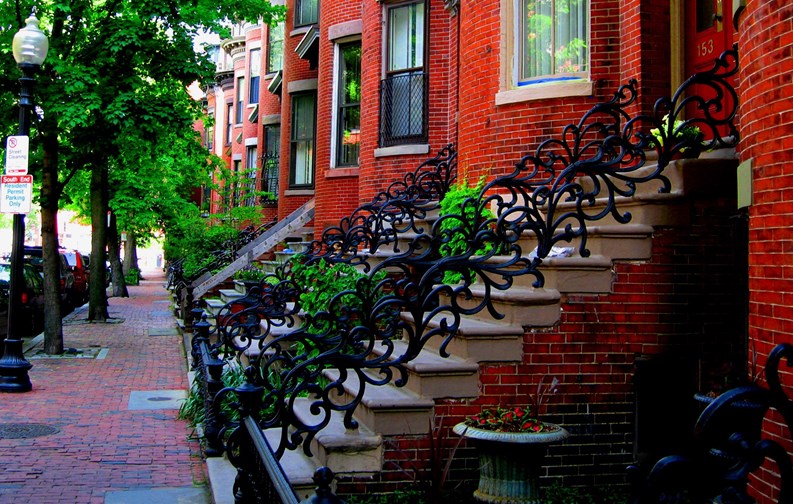
The condo market in Greater Boston is a patchwork of highly localized micro-markets, some of which are currently seeing brisk sales, while others are more subdued. While units in the glass-and-steel luxury towers of the Seaport are experiencing an inventory glut and longer days on market, historic, transit-oriented neighborhoods are enjoying healthy transaction volume.
Chief among these is the South End. Unlike surrounding enclaves where single-family homes or large-scale rentals dictate the housing landscape, the South End real estate market is almost exclusively defined by the buying and selling of condominiums.
A Brief History of the South End
Like any neighborhood in a large metropolitan area, the South End’s real estate trajectory has always been dictated by shifting economic and demographic tides. Built in the mid-19th century on filled-in tidal marshes, the South End was engineered to relieve overcrowding in Beacon Hill and downtown. Modeled after English residential squares, it quickly became a fashionable enclave for Boston’s wealthy merchant class, characterized by the uniform, bow-front Victorian brownstones that still define the neighborhood.
The neighborhood’s initial prosperity was cut short by the Panic of 1873, a catastrophic financial crash in the U.S. and Europe that forced cash-strapped South End elites to liquidate their estates. Seeking to generate immediate income, owners rapidly converted the area’s grand single-family townhomes into high-density tenements and low-rent boarding houses. Appalled by the sudden resulting demographic shift, the old-money elite evacuated the neighborhood entirely, migrating northwest across the rail lines to the newly filled Back Bay—a master-planned enclave where strict deed restrictions legally banned boarding houses and guaranteed architectural conformity.
This economic exodus fundamentally altered the South End, transforming it from a wealthy merchant hub into a dense, working-class melting pot that over the next century became a cultural incubator for jazz musicians, immigrant communities, and other marginalized groups.
Urban Renewal and Gentrification
By the 1960s, the South End was targeted by the Boston Redevelopment Authority for massive urban renewal. While these programs displaced many lower-income residents, they also sparked a historic preservation movement. Spearheaded initially by artists and the LGBTQ+ community in the 1970s and 80s, pioneering buyers purchased dilapidated rooming houses and converted them back into single-family homes or multi-unit condominiums. Over the last 25 years, this steady influx of private capital has transformed the South End into one of the most expensive and sought-after real estate markets in the country.
What’s Selling
While Boston’s citywide median condo price hovers around $725,000, the South End commands a significant premium, maintaining a median sale price just over $1 million with an average price per square foot between $1,112 and $1,200. Well-priced, beautifully renovated properties on historic corridors like Concord Square frequently go under agreement in fewer than 14 days.
The South End buyer demographic tends to be a mix of young STEM and tech professionals, affluent empty-nesters downsizing from MetroWest suburbs like Weston and Wellesley, and young families intent on staying in the city.
In the current market, the properties moving the fastest are restored and updated two-bedroom, two-bathroom units occupying either the parlor levels or the penthouses of historic brownstones. Buyers aggressively pursue units featuring distinctive brick façades, high ceilings, original fireplaces, floor-to-ceiling windows, and private roof decks. Notably, today’s buyers actively prefer to bypass the steep HOA fees associated with full-service luxury high-rises in neighboring districts, opting instead for the lower-overhead, self-managed associations typical of the South End’s brownstone inventory.
Resale Values and Market Resilience
After a historic bull run from 2015 through 2023 during which the median sale price in the South End climbed 46% to a peak of over $1.15 million, the neighborhood is experiencing a period of stabilization. Inventory has climbed nearly 39% year-over-year, providing buyers with genuine leverage for the first time in a decade. Despite this influx of inventory, the South End remains a geographically finite neighborhood with zero room for sprawling new developments. Because structural scarcity insulates the area, properties are still achieving a resilient 97% to 98% of their original list prices.


Leave a Comment