



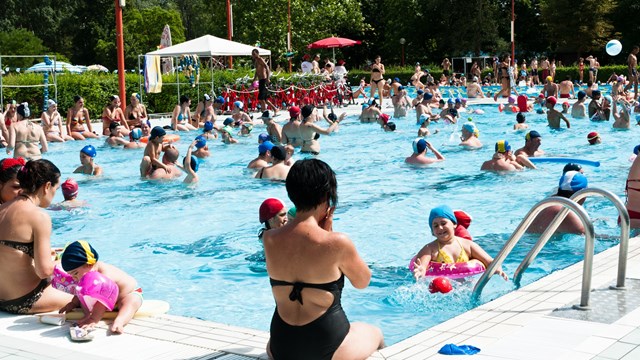
Q. When I bought into a 55-plus condo community, one of the deciding factors for me was the swimming pool. But while looking ahead to summer, I’ve noticed that some of my neighbors seem to baby-sit their grandchildren during school vacations—and I’m a little concerned this might extend into the summer. I understand that they might want to spend quality “family time” with the kids at the pool, but at the same time, I worry about losing any “peaceful enjoyment” of that amenity.
Are there any limits regarding kids that we can legally put on the use of the pool? I’m not suggesting that children be banned, just wondering if the board can post rules about certain times of day, etc., to allow some quieter time for older folks to enjoy it.
—Seeking Quiet Enjoyment
A. “In recent years, the number of age-restricted communities and, consequently, the number of residents of such communities has been expanding greatly—at least if my practice is any indication,” says Gary M. Daddario, a partner with Marcus, Errico, Emmer & Brooks, P.C. in Merrimack, New Hampshire. “It makes some logical sense, given the age of the baby boomer generation, but unfortunately, with more communities and more residents comes more cases involving difficulties and disputes.
“Many of these questions involve the limits of age-restriction for allowing residency within the community. This question presented here is a bit of a tangent on that concept—can there be restrictions on guests’ use of the amenities in an age-restricted community where they don’t themselves reside?
“As a starting point, age-restricted communities can only exist as an exception to what would otherwise be applicable laws prohibiting discrimination of the basis of age, or against families with children. Since their very existence serves as an exception to the anti-discrimination rules, it follows that age-restricted associations can impose restrictions designed to serve their purposes.
“That said, in order to have valid, enforceable restrictions, the rules do need to comply with certain aspects of the law.
“First, the rules should be ‘neutral on their face.’ In other words, they should not openly discriminate on the basis of age (e.g. ‘No Swimmers Under Age 12’), but rather appear to apply to everyone (e.g. ‘7-9am is for lap swimming or exercise activity only’). Other restrictions could enforce the general nature of the age-restricted community status (e.g. ‘Morning swim from 7-9am is for 55+ swimmers only’). However, be careful not to impose strict general prohibitions (e.g. ‘Under 13 not admitted,’ or ‘No children in the deep end’), as these types of rules can be challenged. Another alternative is to designate certain time periods when guests are allowed (versus resident-only times). Rules pertaining to safety are also allowed, and can withstand challenges if they apply to everyone (e.g. ‘Guests must be accompanied by a resident at all times,’ ‘No running in the pool area,’ ‘No jumping from the pool deck,’ etc.).
“Through adoption and enforcement of the types of allowable rules described above, the governing board of an age-restricted community should be able to balance interests and needs to maintain an amenity such as a pool for enjoyment by all.”



Leave a Comment