


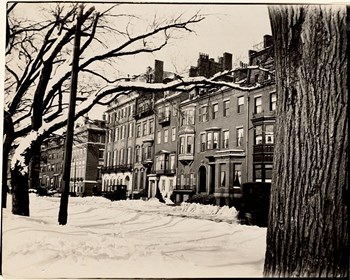
Condominiums and HOAs dominate the multifamily housing market in Massachusetts, but according to the Massachusetts Association of Housing Cooperatives (MAHC), the state is also home to roughly 175 legally incorporated residential cooperatives—around 50 of which can be found in and around Boston. The oldest of these are an interesting blend of early experiments in philanthropic housing, shared student community housing, and classic stock-cooperative apartment buildings.
The Boston Co-operative Building Company (1871)
The concept of cooperative housing in Boston goes back to May of 1871, when the Massachusetts Legislature incorporated the Boston Co-operative Building Company.
Founded by civic leaders and philanthropists including William Gray, Abby May, and Anna Cabot Lodge, the company was created as an ‘investment philanthropy’ aimed at improving housing conditions for working-class and recently immigrated families. While called a ‘cooperative’ and structured on shared civic investment, it really functioned as reformist rental housing rather than modern equity-based homeownership. That’s because rather than operating purely for profit, the organization built and managed tenement blocks and row houses where rental income was reinvested directly into building upkeep and social programs for tenants.
One of its most famous surviving structures is the 1886 brick tenement block at the corner of Thacher and Endicott Streets in the North End—a building best known today as the flagship location of Regina Pizzeria.
HER House (1928)
The title for the oldest continuously member-run residential cooperative in Boston—and indeed, the entire country— belongs to the Harriet E. Richards Cooperative House (HER House) at Boston University.
Founded in 1928 in the Back Bay West/Kenmore area, HER House was established to drastically lower room-and-board costs for female students in an era when higher education was financially out of reach for many women. Residents governed the property democratically, split chores, cooked shared meals, and managed house operations. Nearly a century later, the brownstone on Bay State Road continues to operate under the same cooperative structure, and is home to up to 24 undergraduate students.
Pre-War Luxury Stock Cooperatives (1920s)
Boston’s oldest surviving examples of traditional stock cooperative apartment buildings, whose residents hold shares in a corporation that owns the real estate and grants proprietary leases for their individual units, emerged during the luxury apartment boom of the 1920s.
Prior to the rise of modern condominium associations in the 1960s, stock co-ops were the primary way to ‘own’ an apartment in a multifamily building. High-end residential enclaves like Beacon Hill and the Back Bay saw grand single-family townhouses converted into cooperative corporations, as well as larger buildings built specifically as luxury co-ops.
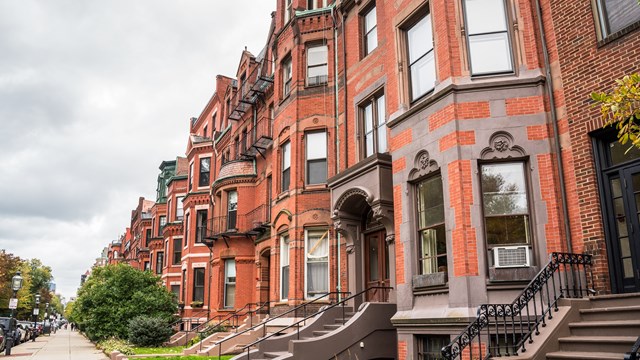
Throughout the mid-20th century, several historic 19th-century brick brownstones along Beacon Street and Commonwealth Avenue were restructured as housing cooperatives, preserving their late-Victorian facades while pioneering multifamily co-ownership in the city. By contrast, the 10-story Classical/Colonial Revival building at 81 Beacon Street overlooking the Public Garden on Beacon Hill was built in 1926 specifically as a luxury cooperative featuring single-floor residences.
Why So Few Co-ops?
While these communities have certainly stood the test of time, and been joined over the years by limited-equity buildings, affordable senior communities, and artist residences built on the cooperative model, the number of private market-rate residential stock co-ops in Boston (and Massachusetts and New England more broadly) is tiny compared to say, New York City, where roughly 70% to 75% of the co-owned apartment inventory consists of cooperatives, with condominiums making up the remaining 25% to 30%.
Why the huge differential? In Massachusetts, it’s partly due to the state’s Condominium Master Deed Law (M.G.L. Chapter 183A). In the early 1960s, Massachusetts was an early adopter of legislation enabling modern condominium ownership. Developers and buyers in Boston overwhelmingly favored the condominium model because condo owners own real property, holding a deeded title to their unit rather than shares in a corporation. Historically, many local lenders found condo unit mortgages easier to underwrite than cooperative share loans, which made individual mortgages simpler to obtain, and in turn further accelerated the shift toward condos during the mid-20th-century apartment boom.


Leave a Comment